
Karauli Rajasthan Travel Guide (2026 Edition)
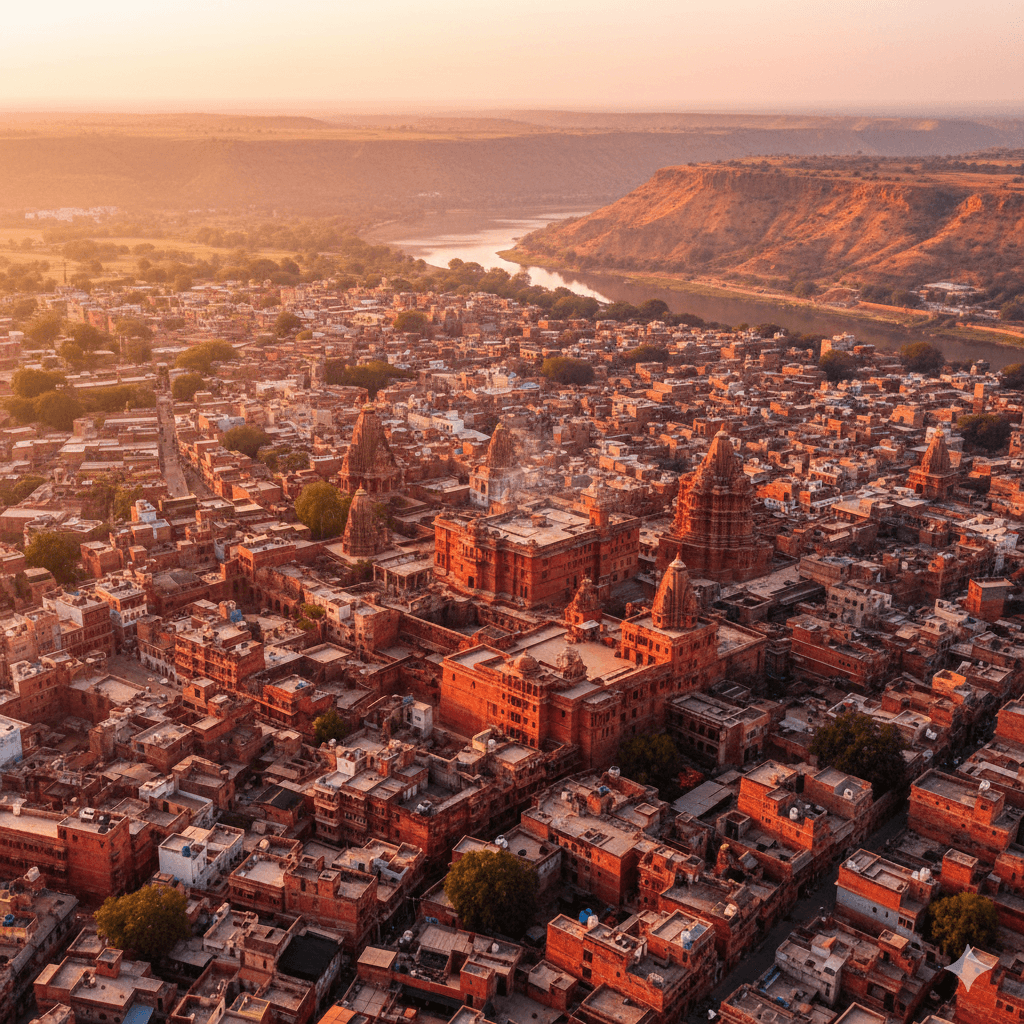
Karauli City Palace Sunset Glow
1. Introduction: The Red Sandstone Kingdom of Karauli
In this Karauli Rajasthan Travel Guide, we aren’t just looking at sights; we are conducting a professional evaluation of a destination that serves as the bridge between the valor of the Rajputs and the devotional Brij culture. As a former travel agent, I’ve seen thousands of itineraries that skip Karauli Rajasthan Travel Guide, yet those who make the detour often describe it as the only “authentic” kingdom left in the state. This is not the commercialized Rajasthan of Jaipur or the lake-front luxury of Udaipur; this is a rugged, red-sandstone citadel where the Yaduvanshi lineage (descendants of Lord Krishna) still holds a living connection to the land.
In this Karauli Rajasthan Travel Guide, we aren’t just looking at sights; we are conducting a professional opinion of a destination that serves as the bridge between the valor of the Rajputs and the devotional “Brij” culture of neighboring Uttar Pradesh.
The “Globalopollis” Strategic Overview
Before we dive into the narrow gullies and ancient shrines, we must understand the “Market Position” of Karauli Rajasthan Travel Guide. It is a destination defined by its Spiritual ROI and its Architectural Integrity. While other cities have renovated their heritage into boutique hotels, Karauli has kept its 14th-century walls, its bustling local markets, and its ancient rituals intact.
Agent’s Insider Truth: If you are seeking “Instagrammable” perfection without the crowds, Karauli Rajasthan Travel Guide is your highest-value asset. It offers the same grandeur as the Mehrangarh or Amer forts but with 90% less foot traffic.
I. The 2026 Logistics: At a Glance
To help you plan with precision, here is the technical breakdown of the Karauli landscape.
| Data Point | Metric/Detail | Strategist’s Note |
| Primary Focus | Heritage & Spirituality | The “Brij” cultural influence is heavy here. |
| Key Architectural Material | Red Sandstone (Chuli) | The same stone used for the Delhi Red Fort. |
| Best Connectivity | Hindaun City (Railway) | 30km away; the most reliable entry point. |
| Vibe Rating | Traditional / Sacred | Not a “party” destination; respectful attire is key. |
| Tourist Density | Low to Moderate | Peaks during the Kaila Devi Fair (March/April). |
| Suggested Stay | 2 Nights / 3 Days | Essential to cover both the Forts and the Sanctuary. |
II. Why Karauli? (The Value Proposition)
Why should a global traveler prioritize this “Red City” in 2026? We’ve audited the top five reasons that make Karauli Rajasthan Travel Guide a “Must-Include” on any professional Rajasthan itinerary:
- The Unbroken Lineage: Unlike many royal families who moved to the capitals, the Maharaja of Karauli still resides in the Bhanwar Vilas Palace, maintaining a tangible link between the city’s history and its modern governance.
- The Shakti Center: Karauli houses the Kaila Devi Temple, one of the most significant pilgrimage sites in North India, offering a raw, high-energy spiritual experience that no “luxury ashram” can replicate.
- Architectural Diversity: You will find a unique blend of Jain, Rajput, and Mughal styles coexisting within a 5-mile radius—a dream for architectural enthusiasts and photographers.
- The Chambal Proximity: Karauli serves as a gateway to the Chambal River Basin, offering a wilder, more aquatic adventure than the typical desert safaris of Jaisalmer.
- The “Slow Travel” Champion: There are no touts here. There are no “tourist prices.” The local market (Bazar) functions for the residents, allowing you to witness genuine Rajasthani trade and craftsmanship.
III. The “Net Rate” of Timing (Seasonal)
Planning your entry into Karauli Rajasthan Travel Guide requires an understanding of the local climate cycle. As your teacher, I recommend the following windows:
- The “Golden Window” (October to March):
- Pros: Perfect weather (10°C to 25°C). The orange harvest in nearby regions is in full swing.
- Tip: This is when heritage walks are most comfortable.
- The “Spiritual Peak” (March/April):
- Pros: The Kaila Devi Fair. Over a million pilgrims descend on the city.
- Cons: Logistics become difficult; hotel rates triple.
- Tip: Only visit now if you are a cultural documentarian or photographer.
- The “Monsoon Greenery” (July to September):
- Pros: The red sandstone looks stunning against the lush green hills of the Aravallis.
- Tip: Great for visiting the Panchana Dam, but the wildlife sanctuaries may have limited access.
IV. Navigating the Language & Culture
In Karauli, the “Industry Truth” is that English is not the primary language of commerce. To navigate like a pro, keep these bullet points in mind:
- Dialect: The local tongue is a mix of Hadoti and Braj Bhasha.
- Social Etiquette: A simple “Radhey Radhey” (the common greeting in Brij culture) will open more doors and smiles than a standard “Namaste.”
- Respect the “Parda”: In rural areas, some traditional customs are still observed. Always ask for permission before photographing women in traditional attire.
2. Famous Historical Places: An Architectural & Military
To understand Karauli Rajasthan Travel Guide, one must look at its history through two lenses: Defensive Might and Devotional Art. The historical sites here aren’t just ruins; many are living spaces where the rituals of the 14th century continue into 2026. This Karauli Rajasthan Travel Guide the primary historical assets that every serious traveler must include in their itinerary.
I. The Karauli City Palace (The Crown Jewel)
Constructed in the 14th century by Arjun Pal, the City Palace is a sprawling complex that serves as a masterclass in Rajput-Mughal synthesis. As a strategist, I categorize this as a “High-Retention Asset” because of its untouched authenticity.
- The Durbar Hall: The main assembly hall reveals a breathtaking array of frescoes and mirror work (Sheesh Mahal) that rivals the grandeur of the Jaipur City Palace but with a more intimate, “lived-in” feel.
- The Stone Lattice (Jali) Work: The palace is famous for its intricate stone screens. These weren’t just decorative; they were functional “climate control” systems designed to keep the interiors cool during the harsh Rajasthani summers.
- The Rang Mahal: A dedicated wing for royal festivities, featuring murals that depict the life of Lord Krishna, bridging the gap between royalty and divinity.
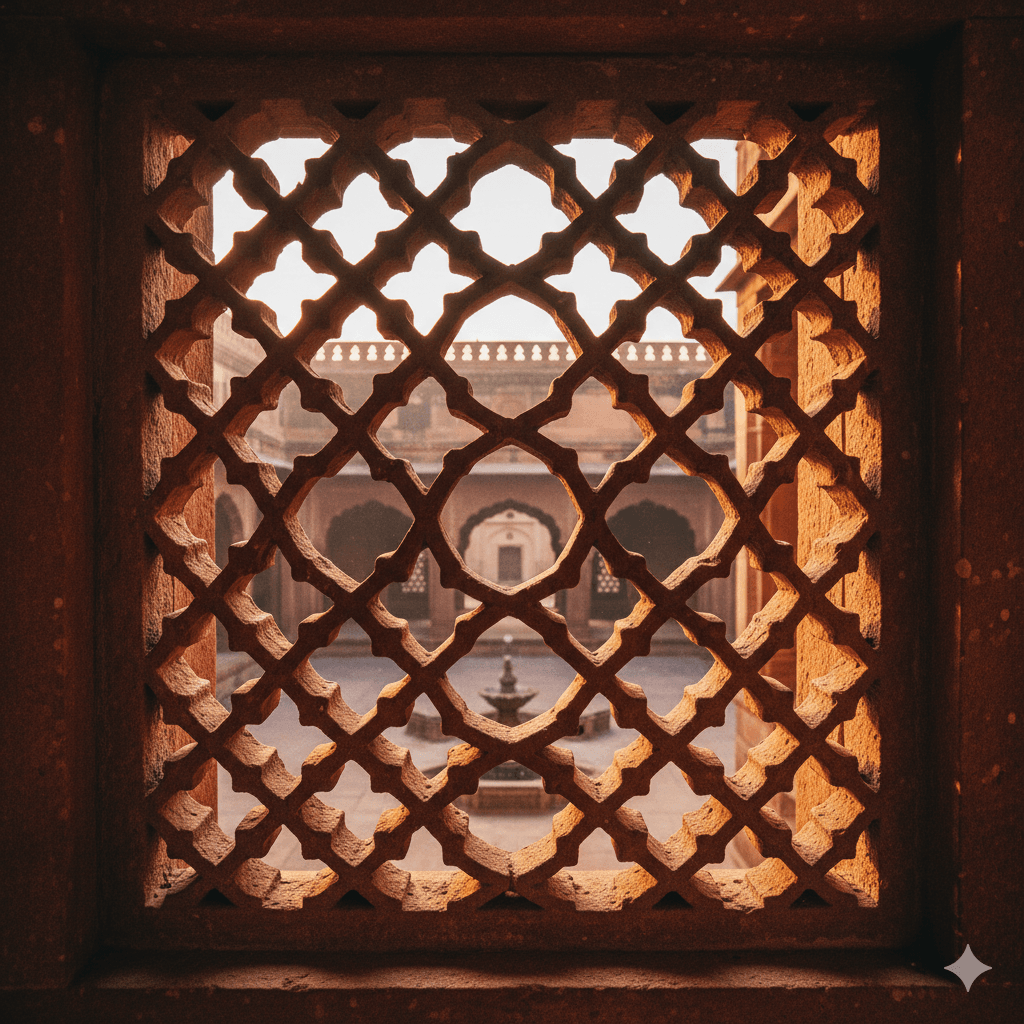
Technical: City Palace Visitor Logistics
| Feature | Data | Pro-Traveler Tip |
| Construction Era | 14th Century (Expanded in 18th) | Look for the transition from rugged stone to refined carvings. |
| Material | Local Red & White Sandstone | The contrast symbolizes the blend of power and grace. |
| Average Visit Time | 2.5 to 3 Hours | Hire a government-approved guide to find the “secret” passages. |
| Photography | Allowed (Fee may apply) | Best light is between 8:00 AM and 10:00 AM. |
| Key Attraction | The Silver Chariot | Used during major festivals; a rare piece of royal transport. |
II. Timangarh Fort: The Echoes of the 11th Century
Located about 40 km from the main city, Timangarh is for the “Hardcore Explorer.” It is a massive hill fort that served as a strategic military outpost. In the travel industry, we call this a “Deep-Value Asset”—it requires effort to reach, but the payoff is immense.
- The Looted Legend: For decades, Timangarh was whispered about in the international art market because of its exquisite “lost” statues. Today, it stands as a testament to the sheer scale of ancient Indian masonry.
- Hidden Water Systems: Our audit of the fort reveals an advanced rainwater harvesting system consisting of massive stone tanks (Baoris), which allowed the garrison to survive long sieges.
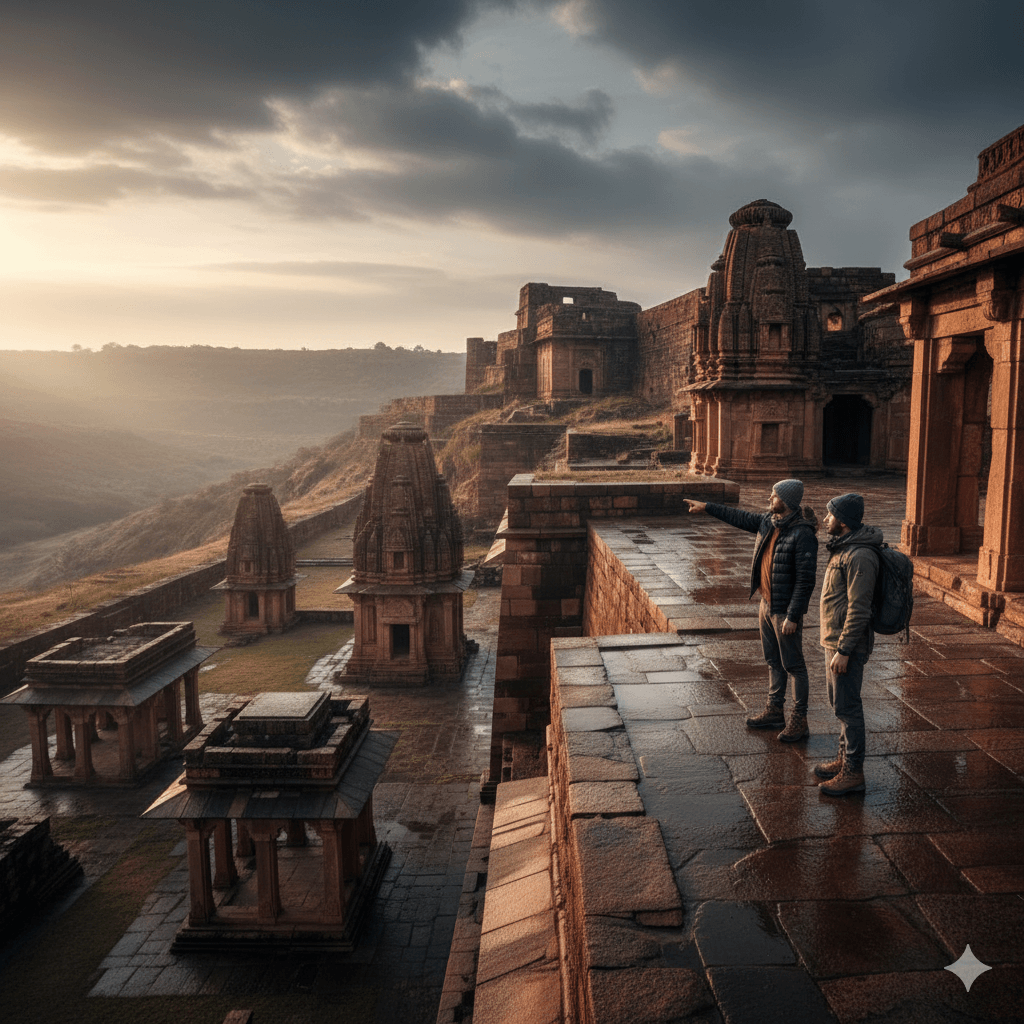
- The Temple Ruins: Inside the fortifications lie the remnants of several temples, showcasing 11th-century carvings that pre-date much of the architecture found in the more famous Rajasthani cities.
III. The Chhatri of Raja Gopal Singh
Cenotaphs (Chhatris) are the silent historians of Rajasthan. The Chhatri of Raja Gopal Singh, located near the river, is the most aesthetically significant funerary monument in Karauli.
- The Vaulted Ceilings: The interior of the dome features exquisite frescoes depicting scenes from the Mahabharata and the Ramayana.
- The River View: Strategically placed on the banks of the Bhadrawati, it offers a serene spot for “Contextual Photography”—capturing the monument against the flowing water.
IV. Comparative Monument of Karauli’s Historical Assets
To help you prioritize your time, I have created this ROI (Return on Investment) table for your historical tour.
| Monument | Historical ROI | Accessibility | Globalopollis Rating |
| City Palace | 10/10 | Easy (Center City) | Must-Visit |
| Timangarh Fort | 9/10 | Moderate (Long Drive) | Adventurer’s Choice |
| Raja Gopal Singh Chhatri | 7/10 | Easy (Near River) | Photographer’s Pick |
| Bahadurpur Fort | 6/10 | Difficult (Ruined) | History Buffs Only |
V. The Strategist’s “Industry Truth” on History
When visiting these sites, remember that Karauli was never fully “conquered” in the way other states were. It maintained a unique subsidiary alliance that allowed its culture to remain pure.
- Cultural Preservation: Unlike the Amber Fort, which sees thousands of tourists a day, the City Palace of Karauli feels like a private residence. You may even encounter members of the royal staff who have served the family for generations.
- The Stone Trade: While at these sites, pay attention to the stone-cutting techniques. The same artisans who maintain these palaces today are part of a guild that has existed for over 500 years.
3. Things to Do & Top Sightseeing Destinations: The Experiential
Karauli Rajasthan Travel Guide offers a rare “Time-Travel” experience. In 2026, where most global destinations are becoming homogenized, Karauli remains stubbornly traditional. This section outlines the essential activities that transform a visitor from a spectator into an active participant in the Karauli legacy.
I. The Spiritual Circuit: A Shakti & Krishna
Religion in Karauli is not just a Sunday affair; it is the city’s primary economic and social driver. To understand the local psyche, you must engage with the three pillars of Karauli’s faith.
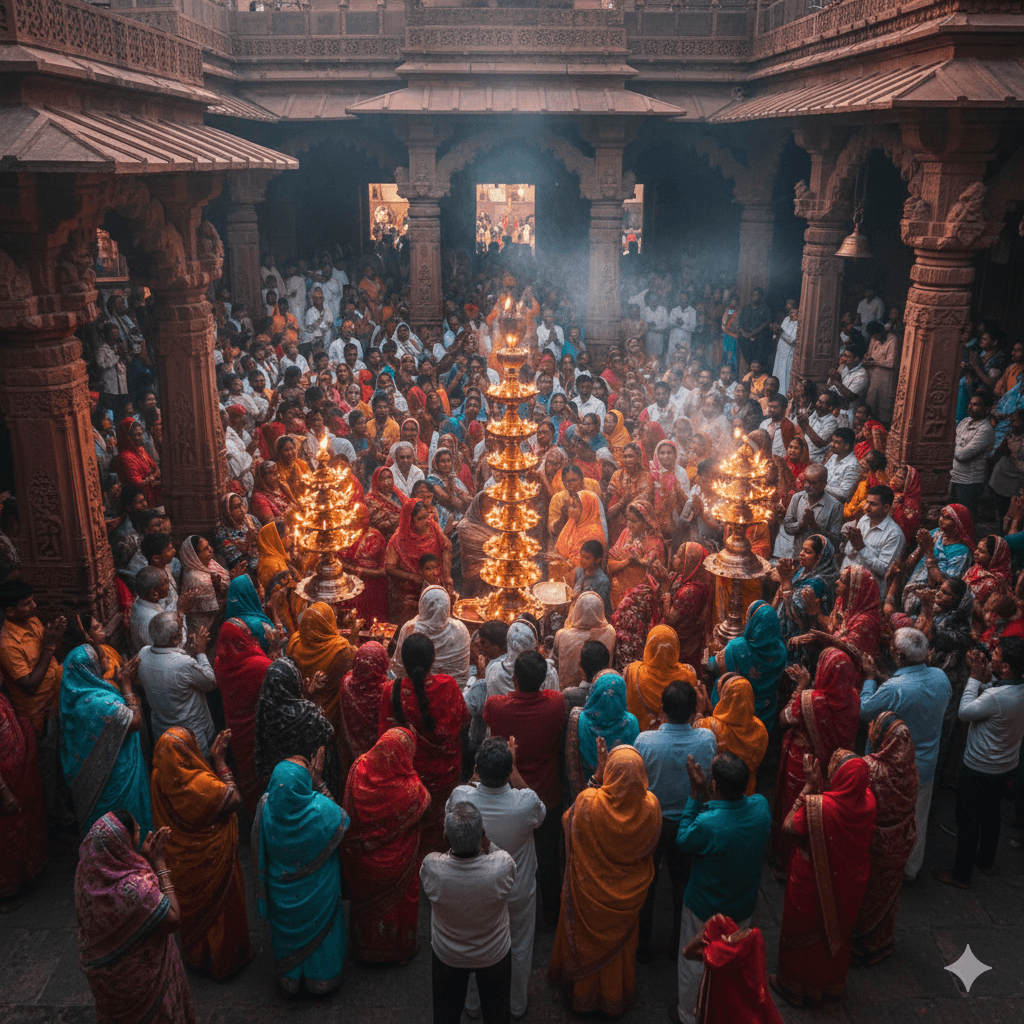
- Attend the Evening Aarti at Madan Mohan Ji: This is the “High-Engagement” activity of the city. As the sun sets, the courtyard of the temple fills with hundreds of locals. The synchronized ringing of bells and the choral chanting create a “Sensory Feast” that is incomparable to the commercialized Aartis of larger cities.
- The Pilgrimage to Kaila Devi: Located 23 km from the main city, this is a “Power Center.” Watching the devotees perform Kanak-Dandoti (prostrating all the way to the temple) is a humbling lesson in human devotion and endurance.
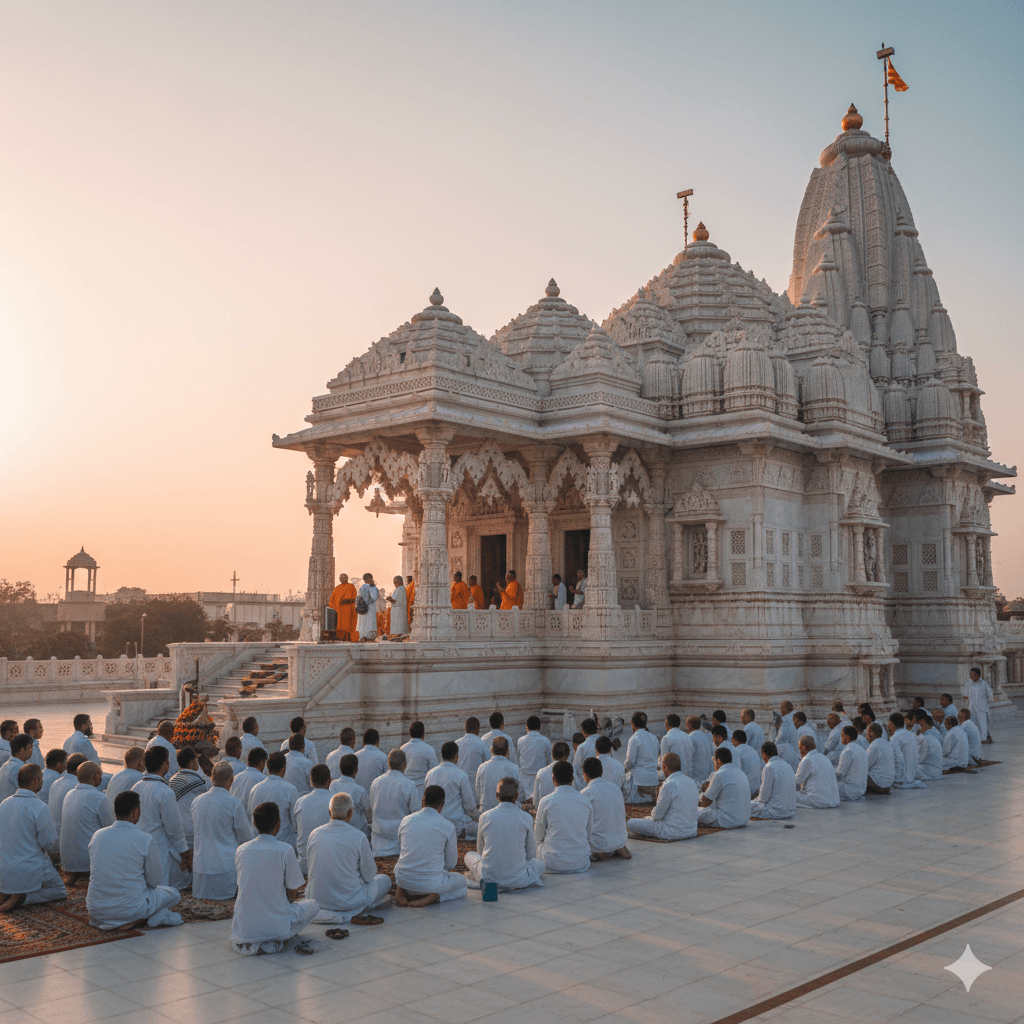
- Jain Heritage at Shri Mahavir Ji: An architectural marvel, this temple is a “Visual Asset” for those interested in intricate marble carvings and a peaceful, meditative atmosphere.
II. The “Globalopollis” Activity Matrix
To help you allocate your “Travel Capital” (time and energy), use this strategic matrix for Karauli’s top experiences.
| Activity | Interest Category | Time Investment | Strategic ROI |
| Old City Heritage Walk | Culture & Photography | 3 Hours | High (True local life) |
| Boating at Panchana Dam | Nature & Relaxation | 2 Hours | Moderate (Great for sunset) |
| Temple Hopping | Spirituality | 4 Hours | Critical (The soul of the city) |
| Lac Bangle Workshop | Artisanship | 1.5 Hours | High (Hands-on learning) |
| Bhadrawati River Sunset | Photography | 1 Hour | High (Best lighting) |
III. The Old City Heritage Walk (The “Insider” Route)
As a strategist, I recommend a guided walk through the old walled city over any vehicle tour. The “Gullies” of Karauli are where the real business of the kingdom happens.
- The Narrow Alleyways: The ancient houses (Havelis) that feature wooden doorways and stone carvings that are centuries old.
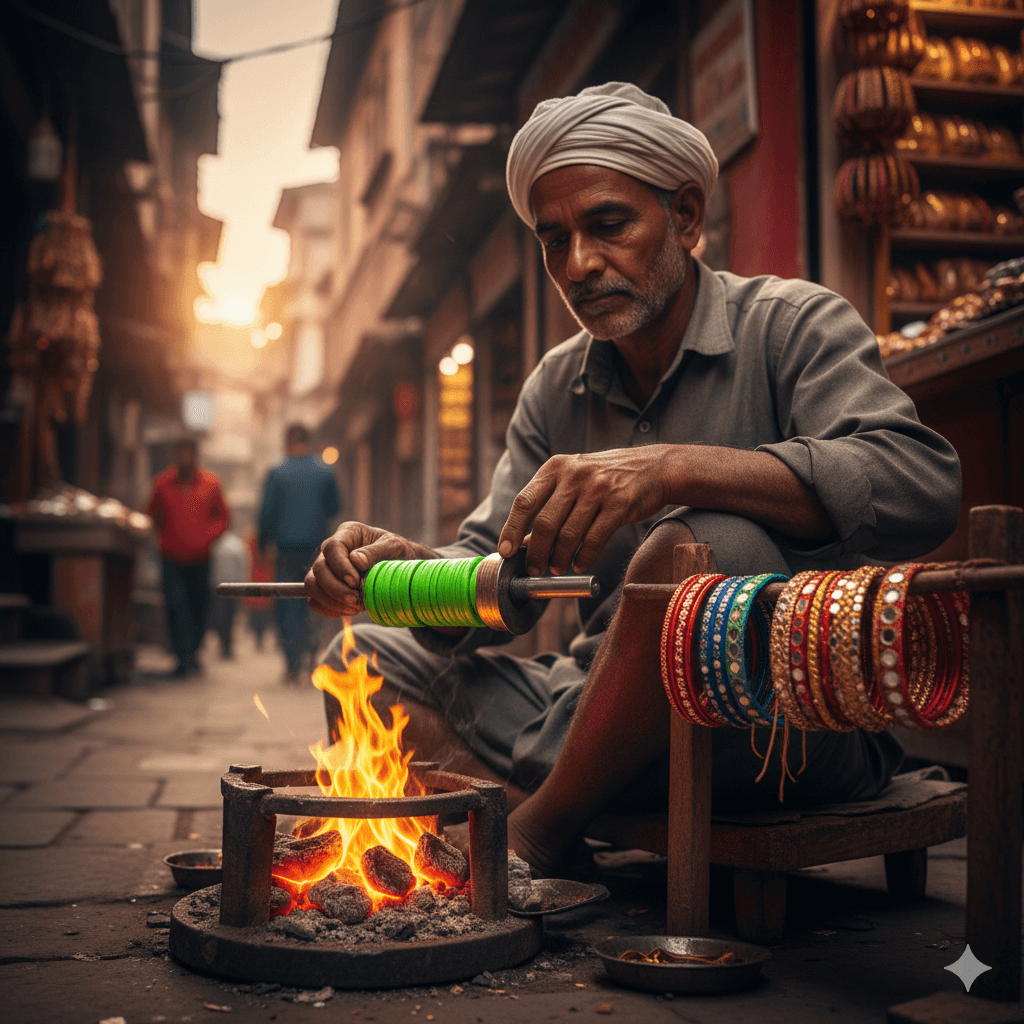
- The Artisan Quarter: Visit the “Maniaro Ki Gali,” where the world-famous lac bangles are made. Watching the artisans melt raw resin over a small charcoal fire to create intricate jewelry is a masterclass in traditional manufacturing.
- The Local Spice Market: Your “Olfactory Heaven” starts here. The smell of fresh turmeric, dried chilies, and local forest honey defines the Karauli air.
IV. Nature & Outdoor Assets
Karauli Rajasthan Travel Guide isn’t just stone and incense; it has a rugged natural side that is often overlooked in standard travel blogs.
- Panchana Dam: This is the largest “Mud Dam” in Asia. In 2026, it has become a hub for birdwatchers. The vast expanse of water against the backdrop of the Aravalli hills provides a necessary “Nature Break” from the dense city environment.
- Kailsil River Exploration: Perfect for those interested in rural life. Watching the local farmers use traditional irrigation methods provides an “Agrarian” of the region.
V. Professional Tips for Sightseeing in Karauli
To maximize your experience, follow these “Agent’s Rules”:
- The “Golden Hour” Rule: In Karauli, the red sandstone looks its best exactly 20 minutes before sunset. Plan your visit to the City Palace or the River Ghats during this window for the best photography.
- The Sunday Surge: Avoid the major temples on Sundays and festival days unless you are looking for the “Crowd Experience.” Queue times can exceed 4 hours during peak religious holidays.
- Footwear Strategy: You will be removing your shoes frequently at temples and palaces. Wear slip-on shoes or carry a small bag to store your footwear.
4. Best Places for Every Interest Group: A Targeted Market
Karauli Rajasthan Travel Guide is a versatile asset. Whether you are Traveling the region for its architectural depth, its spiritual energy, or its rugged “off-grid” potential, you need a tailored roadmap. This section categorizes Karauli’s locations into high-value zones for specific traveler personas.
I. The Segmented Value Matrix
To streamline your planning, our 2026 strategist’s planning and travel has mapped the top locations to specific traveler needs.
| Interest Group | Primary Destination | Secondary Asset | Value Proposition |
| History & Architecture | Karauli City Palace | Timangarh Fort | Deep-dive into 14th-century Rajput masonry. |
| Spiritual & Religious | Kaila Devi Temple | Madan Mohan Ji | Direct access to Shakti Peeth energy. |
| Luxury & Heritage | Bhanwar Vilas Palace | Ramathra Fort | Royal hospitality and “Slow Travel” luxury. |
| Nature & Wildlife | Kaila Devi Sanctuary | Panchana Dam | Rugged terrain and endangered flora/fauna. |
| Photography & Art | Old City Markets | Raja Gopal Singh Chhatri | High-contrast red stone and vibrant street life. |
| Budget & Backpacker | Local Dharamshalas | Hindaun Street Food | Maximum cultural immersion at minimum cost. |
II. For the History & Architecture
If your goal is to document the evolution of Indian stonecraft, Karauli is your “Primary Lab.”
- The City Palace (Intricate Detail): Focus on the Jharokhas (overhanging enclosed balconies). These are architectural masterclasses in “viewing without being seen.”
- Timangarh Fort (Structural Integrity): The massive stone blocks that were moved without modern machinery. It is a study in ancient military logistics.
- Rawal Mahal: A lesser-known historical site that offers a raw, un-restored look at medieval living quarters.
III. For the Spiritual & Devotional Seeker
According to Karauli Rajasthan Travel Guide, it is part of the Brij Bhoomi circuit. For this group, the journey is about “Darshan” (divine viewing).
- Kaila Devi (The Power Center): Best for those seeking the “Mother Goddess” energy. The walk up to the temple is as important as the temple itself.
- Shri Mahavir Ji (The Silent Retreat): For seekers of peace, the Jain complex offers a stark contrast to the high-energy Hindu temples. It is a space for meditation and silence.
- Evening Chanting: Join the local devotees at small roadside shrines for a more intimate spiritual cleansing.
IV. For the Luxury & Heritage Enthusiast
Karauli offers “Authentic Luxury”—which in 2026 means privacy, space, and a lack of artificiality.
- Bhanwar Vilas Palace: This is the residence of the current royal family. Staying here isn’t just a hotel booking; it’s an “Experience” of royal life. The vintage car collection and the organic farm on-site are major value-adds.
- Ramathra Fort: Located on the outskirts, this fort-turned-hotel offers 360-degree views of the lake and countryside. It is the definition of “Secluded Luxury.”
V. For the Adventurer & Wildlife Explorer
Karauli is not for the faint of heart. Its terrain is “Dangs” (rugged ravines and plateaus).
- Kaila Devi Wildlife Sanctuary: This is part of the Project Tiger corridor. This for the rare Chinkara, Wild Boar, and occasionally, leopards migrating from Ranthambore.
- Chambal River Safari: A short drive away, this offers a “Riverine View” where you can spot the rare long-snouted Gharial and the Gangetic Dolphin.
VI. Strategist’s “Interest Group” Rules (2026 Edition)
- The “Slow Move” for Photographers: Do not rush the Old City. The light changes the color of the red sandstone every hour. The “Best Shot” is usually found in the shadows of the noon sun.
- The “Safety” for Solos: Karauli is exceptionally safe, but spiritual centers can be overwhelming. As a solo, hire a local “Heritage Guide” to act as a cultural buffer in crowded temple areas.
- The “Sustainability Note”: If you are a Nature enthusiast, support local eco-guides at the Panchana Dam. They are the frontline defenders of the local ecosystem.
5. Nightlife & Evening Activities: The Twilight
The true character of Karauli Rajasthan Travel Guide emerges when the harsh desert sun dips below the Aravalli horizon. The red sandstone buildings begin to glow with a deep crimson hue, and the city’s spiritual energy reaches its peak. This section shows how to strategically spend your evening hours for maximum cultural “Return on Investment.”
I. The Spiritual Nightlife (The “Jagran” Experience)
Unlike the western concept of a night out, Karauli’s nights are defined by Devotion and Soundscapes.
- The Evening Aarti (Madan Mohan Ji): Between 6:00 PM and 7:30 PM (seasonal), the temple becomes the city’s social hub. The atmosphere is electric with the sound of Manjira (cymbals) and the scent of camphor.
- The Night Jagran (Kaila Devi Temple): Starting around 9:00 PM and often lasting until midnight, the Jagran (devotional vigil) is a high-energy event. Musicians perform folk songs dedicated to the goddess, creating a “Trance-like” cultural atmosphere.
- Deep Dan (River Ritual): On special lunar dates, the banks of the Bhadrawati River see hundreds of small oil lamps floated on the water—a visual Feast of peace and light.
II. The Evening Activity Matrix
Use this table to plan your 6:00 PM to 10:00 PM window based on your traveler persona.
| Time Window | Activity | Location | Vibe |
| 5:30 PM – 6:30 PM | Sunset Photography | City Palace Terrace | Panoramic & Serene |
| 6:30 PM – 7:30 PM | Sandhya Aarti | Madan Mohan Ji Temple | High Energy / Spiritual |
| 7:30 PM – 8:30 PM | Street Food | Old City Bazaar | Vibrant & Gastronomic |
| 8:30 PM – 10:00 PM | Royal Dinner | Bhanwar Vilas Palace | Exclusive & Heritage |
| 9:00 PM – 9:30 PM | Late Night Jagran | Kaila Devi Temple | Cultural Immersion |
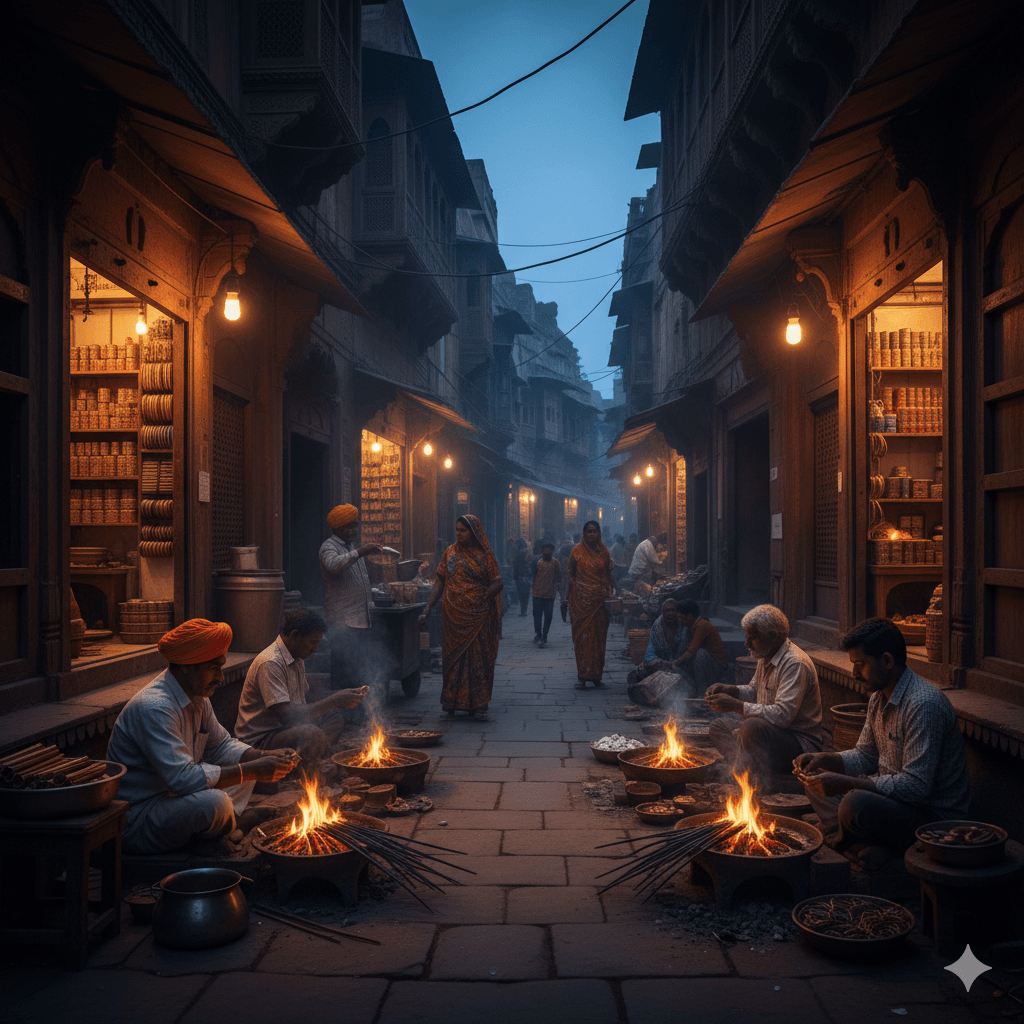
III. Heritage Dining: The “Royal” Evening Economy
For those staying in heritage properties, the evening is about Gastronomy and Narrative.
- The Courtyard Dinner at Bhanwar Vilas: The palace is beautifully lit at night. Dining here often includes a “Royal Chat”—where you might meet the family or senior staff who share oral histories of the kingdom.
- Folk Performances: Many heritage hotels organize local Languriya singers (specific to Karauli Rajasthan Travel Guide) who perform satirical and devotional folk songs during dinner service. This is your best chance to witness the “Living Arts” of the region.
IV. Twilight Photography & The “Red Glow” Strategy
As your teacher, I recommend a specific “Evening Travel” for photographers:
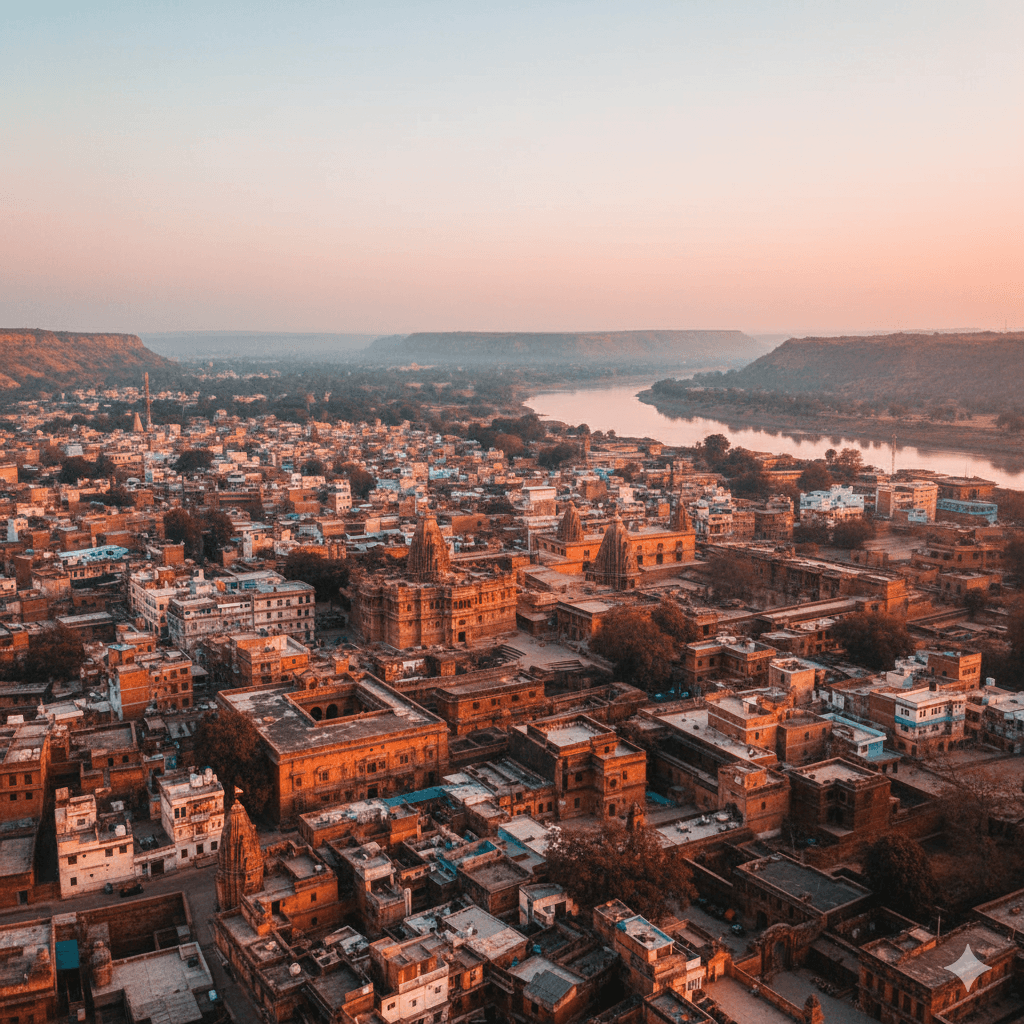
- The Rooftop Perspective: Gain access to a rooftop near the Hindaun Gate just before 6:00 PM. The way the blue hour mixes with the red sandstone and the city lights is a prime visual asset for your article.
- Bazaar Life: The evening market is when the “Lac Bangle” artisans are most active under their yellow tungsten lights. This provides a high-contrast, moody aesthetic for street photography.
V. The “Agent’s Truth” on Late-Night Logistics
To navigate Karauli at night like a professional, keep these “Net Realities” in mind:
- The “Dry” Status: There are no bars or public drinking spots in the city. If you require a drink, it must be consumed within the privacy of high-end heritage hotels like Bhanwar Vilas.
- Transportation: E-rickshaws and auto-rickshaws operate until about 9:00 PM. After that, you must have a pre-arranged vehicle or be staying within walking distance of the city center.
- Dress Code: Even at night, modest dress is required near temple zones. A light shawl or jacket is recommended, as the desert temperature drops significantly after dark.
6. Adventure & Outdoor Activities: The “Dang” Plateau
The “Dang” refers to the unique topography of Karauli and Karauli Rajasthan Travel Guide—a series of steep sandstone escarpments and deep river valleys. For the adventure traveler, this is a “High-Value Frontier.” It is untamed, poorly mapped on mainstream apps, and requires a professional “Field Travel” to navigate successfully.
I. The Kaila Devi Wildlife Sanctuary Safari
This sanctuary serves as the critical “Buffer Zone” for the Ranthambore Tiger Reserve. In 2026, it has emerged as the preferred choice for those who find Ranthambore too commercialized.
- Tiger Corridor Tracking: While tiger sightings are rarer than in Ranthambore, the thrill here is in the “Tracking.” You are traveling a living corridor used by migrating big cats.
- The Sloth Bear Territory: Karauli’s caves and rocky outcrops are prime habitats for the Indian Sloth Bear. A sighting here is a “High-Utility” experience for wildlife photographers.
- Birdwatching at Kalisil: The sanctuary is home to a massive population of raptors, including the Egyptian Vulture and the Honey Buzzard.
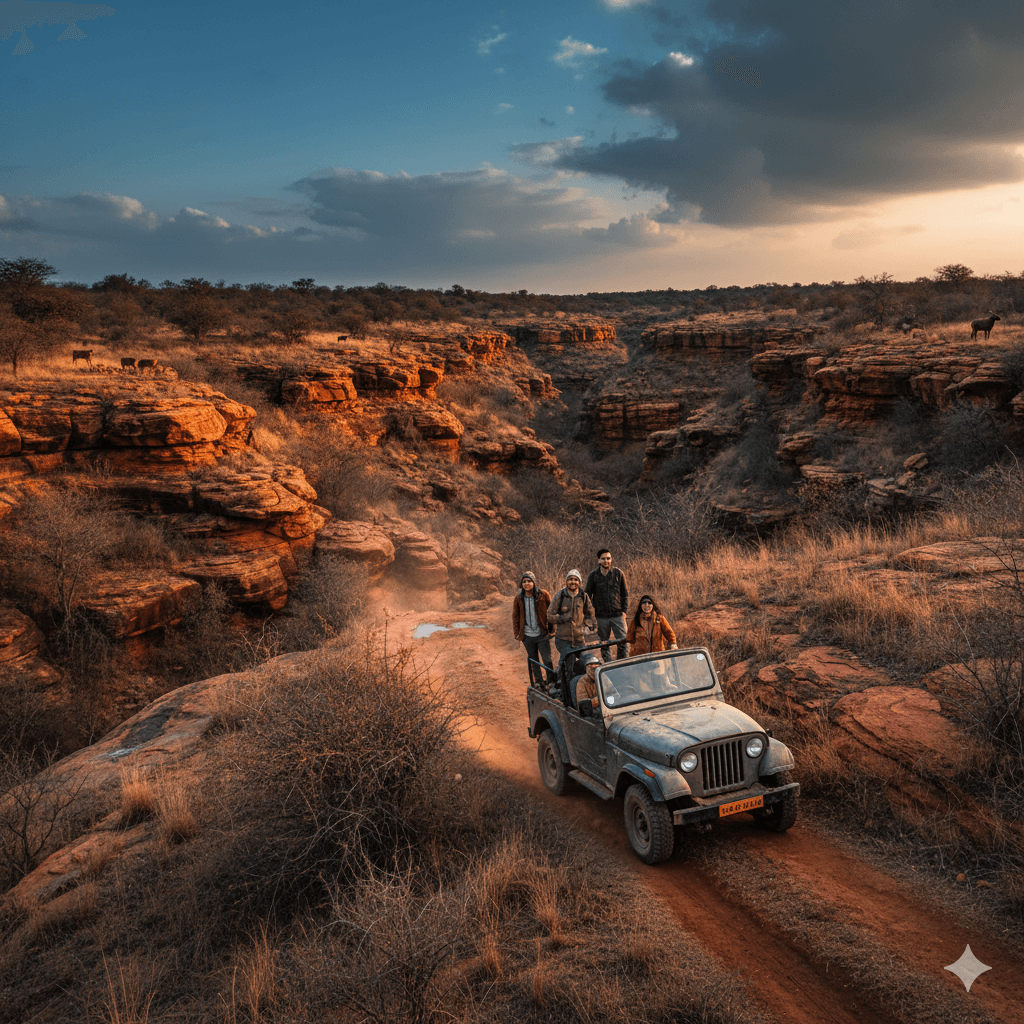
II. The Adventure Activity Matrix
Use this table to physical requirements and “Thrill ROI” of Karauli’s outdoor offerings.
| Activity | Difficulty Level | Primary Asset | Strategist’s ROI |
| Jeep Safari (Sanctuary) | Moderate | Apex Predators / Flora | High (The most popular choice) |
| Chambal River Safari | Easy | Gharials & Dolphins | Very High (Rare species access) |
| Ravine Trekking | Strenuous | Geological Formations | High (For fit travelers only) |
| Night Camping | Easy/Moderate | Star-gazing / Silence | Moderate (Great for mental reset) |
| Boating (Panchana) | Very Easy | Aquatic Birdlife | Low/Moderate (Relaxation focused) |
III. The Chambal River Expedition: An Aquatic Travel
A short drive from Karauli lies the National Chambal Sanctuary. This is one of the few places in the world where you can perform a “Riverine” of prehistoric species.
- The Gharial Watch: The long-snouted, fish-eating crocodile is the star here. Watching these 15-foot reptiles sunbathe on the sandbanks is a visual asset you won’t find elsewhere in Rajasthan.
- The Gangetic Dolphin: If your timing is right (early morning), you can spot the rare fresh-water dolphins surfacing. This is a “Critical Value” experience for eco-travelers.
- Skimmer Colonies: For birders, the Indian Skimmer nesting sites on the river islands are a world-class attraction.
IV. Ravine Trekking & Rock Exploration
For those who want to use their “Physical Capital,” the ravines (Dangs) around Timangarh Fort offer a unique trekking landscape.
- Caves of the Hermits: The sandstone hills are honeycombed with small caves, some still used by local ascetics. This provides a “Cultural-Adventure” hybrid experience.
- The Red Rock Scramble: Unlike the granite of the Aravallis, the red sandstone provides excellent grip for light rock scrambling. It is a “Tactile Heaven” of the earth itself.
V. The “Agent’s Truth” on Adventure Safety
Adventure in Karauli is “Real,” which means it comes with real logistics. Follow these professional rules:
- Hire a Local “Dang” Guide: The ravines are a labyrinth. Without a local who knows the paths and the weather patterns, it is easy to get disoriented.
- The Wildlife Rule: Always maintain a minimum 30-meter distance from Sloth Bears. They are unpredictable and territorial.
- Hydration Logistics: The sandstone reflects heat. Even in winter, the “Dang” can be dehydrating. Carry 20% more water than you think you need.
- Vehicle Requirement: Do not attempt to take a standard sedan into the Kaila Devi Sanctuary. A high-clearance 4×4 is a non-negotiable “Business Expense” for this segment.
7. Nearby & Surrounding Attractions: The Regional Hub
Karauli Rajasthan Travel Guide is strategically positioned. To its north lies the spiritual intensity of Mehandipur; to its west, the rugged wilderness of Ranthambore; and to its south, the hidden lakeside forts. This section breaks down the “Day Trip” assets that turn a 2-day stay in Karauli into a comprehensive 5-day regional expedition.
I. The “Satellite” Value Matrix
To help you calculate your travel logistics, our strategist’s has mapped the top surrounding assets by distance and primary appeal.
| Destination | Distance from Karauli | Primary Asset | Strategist’s ROI |
| Ramathra Fort | 25 km | Lakeside Heritage | High (The best luxury day-trip) |
| Mehandipur Balaji | 45 km | Spiritual/Exorcism | Critical (Global phenomenon) |
| Shri Mahavir Ji | 30 km | Jain Architecture | High (Artistic & serene) |
| Hindaun City | 30 km | Ancient Stepwells | Moderate (History buffs only) |
| Ranthambore (North) | 60 km | Apex Predators | Very High (Alternative entry) |
II. Ramathra Fort: The Lakeside Sentinel
If Karauli is the “Red City,” Ramathra is the “Lakeside Fortress.” Located a short drive away, this 350-year-old fort overlooks the Kalisil Dam.
- The Viewpoint : The fort is situated on a high ridge, offering 360-degree views of the countryside. In 2026, this is considered one of the best “Sundowner” spots in Rajasthan.
- Rural Immersion: The surrounding village of Ramathra is a “Clean Place” of traditional Rajasthani farming. You can take a camel cart ride through the mustard fields to see the local “Jharokha” houses.
- Boating & Birding: The Kalisil Lake at the foot of the fort is a haven for migratory ducks and cranes during the winter months.
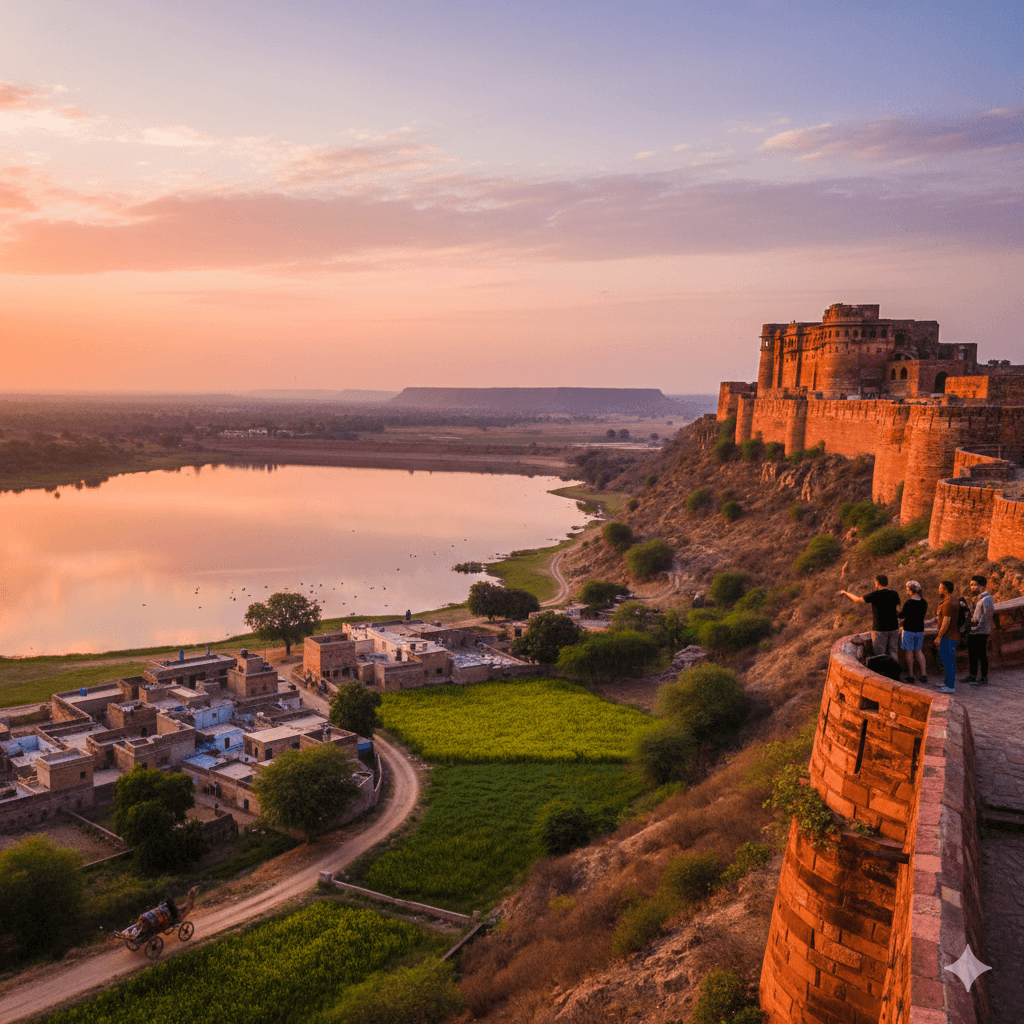
III. Mehandipur Balaji: The Spiritual Mystery
As your teacher and strategist, I must mention that this is not a typical “tourist temple.” It is a world-renowned center for what locals call “healing from dark energies.”
- The Cultural: This is a high-intensity environment. You will witness rituals that are raw and deeply traditional. It is a “Must-Visit” for those interested in the psychological and spiritual fringes of Indian culture.
- Logistics Warning: The crowds here are massive. Use the “Early Entry Strategy” (be there by 5:00 AM) to avoid a 6-hour queue.
IV. Shri Mahavir Ji: The Pinnacle of Jain Art
Often visited as a half-day trip from Karauli, this temple complex is dedicated to the 24th Tirthankara of the Jains.
- Architectural ROI: The temple is constructed entirely of white marble and red sandstone, featuring carvings so fine they look like lace.
- The Museum: There is a small on-site museum that houses 11th-century idols discovered in the area, providing a “Deep History” context to your Karauli Rajasthan Travel Guide trip.
V. Hindaun City: The “Ancient Stepwell”
Hindaun is often overlooked, but for an architectural enthusiast, it contains several “Hidden Assets.”
- Nakkash Ki Devi: A beautiful temple with intricate stone carvings that rival the main City Palace.
- Jacha Ki Baori: An ancient stepwell that serves as a masterclass in medieval water engineering. While it requires a “Cleanliness” (as it is not fully restored), its structural scale is impressive.
VI. The “Agent’s Truth” on Regional Travel
- The Road Quality: Most roads leading out of Karauli toward Hindaun or Ramathra are single-lane but well-paved. However, expect slow movement due to cattle and local markets.
- The “Combined Circuit”: A professional “Travel Agent Hack” is to visit Shri Mahavir Ji and Hindaun City on the same day, as they lie in the same direction.
- Transport Logistics: Do not rely on public buses for these day trips if you are on a tight schedule. Hire a private taxi for the day (Current 2026 Rate: approx. ₹2,500 – ₹3,500) to ensure you can see all three “Satellite” sites.
8. Comprehensive Top List: The Globalopollis “High-Value” Rankings
To navigate Karauli Rajasthan Travel Guide like a professional, you must prioritize your time based on the “Information Gain” each site provides. We have shown these locations against the 2026 travel landscape to give you a definitive ranking.
I. The Globalopollis Power Rankings (Top 10)
| Rank | Destination | Strategic Category | Why it Wins |
| 1 | Karauli City Palace | Architectural Asset | The most authentic “living” palace in Rajasthan. |
| 2 | Kaila Devi Temple | Spiritual Asset | High-energy Shakti Peeth with zero commercial fluff. |
| 3 | Madan Mohan Ji | Cultural Asset | The evening Aarti is the city’s sensory peak. |
| 4 | Timangarh Fort | Adventure Asset | Massive scale; perfect for “Fort Travelers.” |
| 5 | Bhanwar Vilas Palace | Heritage Asset | Best “Royal Lifestyle” immersion. |
| 6 | Ramathra Fort | Nature/Luxury Asset | Unbeatable sunset views over Kalisil Lake. |
| 7 | Shri Mahavir Ji | Artistic Asset | Pinnacle of Jain marble carving & tranquility. |
| 8 | Panchana Dam | Ecological Asset | Asia’s largest mud dam; a birdwatcher’s dream. |
| 9 | Old City Bazaar | Economic Asset | The world center for authentic lac craftsmanship. |
| 10 | Mehandipur Balaji | Mystery Asset | A global center for spiritual “healing”. |
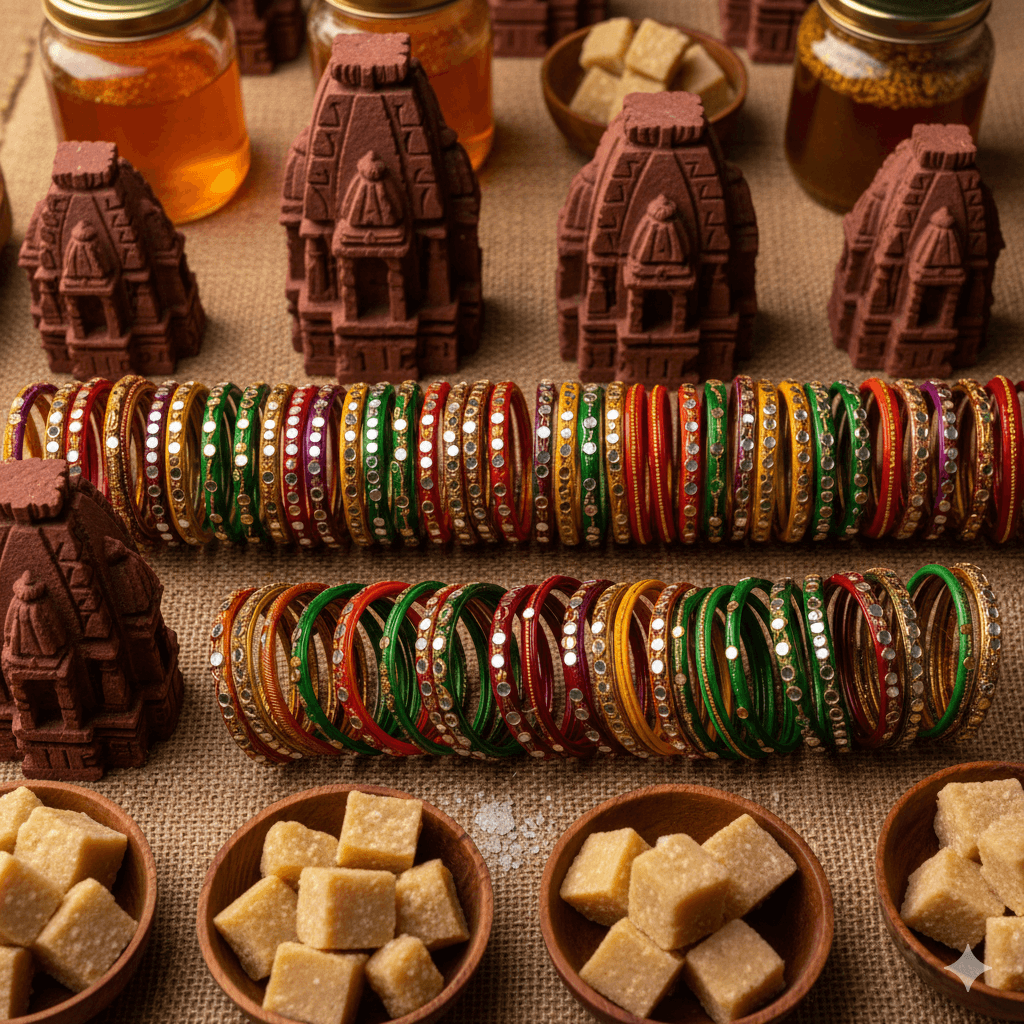
II. Detail of the Top 3 “Critical Assets”
1. Karauli City Palace (The Heritage)
- The Durbar Hall: The glass inlay work and the hand-painted frescoes. Unlike the “restored” palaces of Jaipur, the paint here is aged and original, providing a “True History” feel.
- Lattice Jali Screens: Look for the sandstone screens that allow cool air to pass through while providing privacy. It’s 14th-century air conditioning.
- The Silver Chariot: Housed within the palace, this is a massive asset used only during the Janmashtami festival.
2. Kaila Devi Temple (The Spiritual)
- The Courtyard Energy: Watch for the Languriya singers. Their unique folk songs are specific to this temple and represent the “Intangible Heritage” of Karauli.
- The River Connection: The temple sits on the banks of the Kalisil River. The bridge crossing is a “High-Utility” spot for landscape photography.
- Logistics: The temple operates 24/7 during fairs, but the “Pro” time is 4:00 AM for the first morning prayer.
3. Madan Mohan Ji (The Social)
- The Brij Influence: This temple links Karauli to the Krishna circuit of Mathura. The deity was brought here for protection during the Mughal era.
- Community Impact: This is where the local “Business Intelligence” of the city meets. You can observe the social hierarchy and community bonds of the kingdom in a single hour.
III. The “Globalopollis” Niche List: The Best For…
- Best for Solo Travelers: The Heritage Walk. It’s safe, engaging, and allows you to move at your own pace through the “gullies.”
- Best for Couples: Sunset at Ramathra Fort. The 360-degree view of the water and the ruins is the most romantic “Visual Asset” in the district.
- Best for Content Creators: The Lac Bangle Market. The high-contrast colors of the resin and the fire provide excellent “Process Reels” for social media.
- Best for History Buffs: Timangarh Fort. It requires a 40-minute hike, but the ruins of the 11th-century temples inside the fort are a “Deep History” goldmine.
IV. The “Agent’s Truth” on the Top List
- Don’t Try to “Finish” the List: Karauli is a “Slow Destination.” If you try to see all 10 in one day, your “Experience ROI” will plummet.
- The “Palace-Temple-Market” Triangle: If you only have 24 hours, stick to these three. They are within 2km of each other and provide the complete essence of the kingdom.
- The Sunday Disclaimer: Rankings 2, 3, and 7 move to the bottom of the list on Sundays due to extreme crowd density. If your Travel falls on a weekend, prioritize the Forts and the Dam instead.
9. Things to Buy or Shop: The Artisan & Economic
Shopping in Karauli according to Karauli Rajasthan Travel Guide is an exercise in “Ethical Sourcing.” You aren’t just buying a product; you are supporting a 500-year-old guild system. This section high-value crafts and local products that represent the material soul of the kingdom.
I. The Lac Bangle Industry (The Globalopollis Gold Standard)
Karauli is the undisputed capital of Authentic Lac Work. Unlike plastic or glass bangles, Lac is a natural resin secreted by insects, making these items eco-friendly and culturally significant.
- The Process: Visit the Maniaro Ki Gali (Bangle Sellers’ Lane). Here, you can watch the “Master Artisans” heat the lac over small charcoal fires, shaping them with wooden mandrels.
- The “Gota” Work: Look for bangles inlaid with tiny mirrors or gold-threaded “Gota” work. These are the “Premium Assets” of the Karauli market.
- The Strategist’s Tip: Lac is sensitive to extreme heat. Ensure your “Post-Purchase Logistics” include keeping these in a cool, padded box for the journey home.
II. The “Souvenir ROI” Matrix
To help you allocate your “Shopping Capital,” use this strategic matrix for Karauli’s local goods.
| Product | Cultural Value | Portability | Globalopollis Rating |
| Lac Bangles | 10/10 | High | Must-Buy (World-class quality) |
| Red Sandstone Models | 9/10 | Low (Heavy) | Collector’s Choice (Iconic material) |
| Karauli Peda (Sweets) | 8/10 | Moderate | Foodie’s Pick (Short shelf life) |
| Brij-style Textiles | 7/10 | High | Fashion Asset (Unique embroidery) |
| Forest Honey | 9/10 | Moderate | Health Asset (Organic & Raw) |
III. Red Sandstone Artifacts: The “Dharma” of Stone
The same stone used for the City Palace and the U.S. White House (sourced from nearby) can be bought in miniature form.
- Hand-Carved Shrines: Small, intricate temples carved from a single block of red sandstone are the most sought-after items for interior designers and spiritual visitors.
- The “Tactile”: Run your hand over the stone. Authentic Karauli sandstone has a fine grain and a natural “warmth” that synthetic imitations cannot replicate.
IV. Gastronomic Souvenirs: The “Brij” Flavors
Karauli’s proximity to the dairy-rich Braj region makes its sweets a “High-Value Commodity.”
- Karauli Peda: A dense, milk-based sweet flavored with cardamom. It is less sweet than the industrial versions found in cities, offering a “Pure Flavor.”
- Wild Forest Honey: Sourced from the Kaila Devi Sanctuary, this honey is multi-floral and organic. As a strategist, I categorize this as a “High-Trust Asset” because it is collected by local tribal communities.
V. The “Agent’s Truth” on Shopping Logistics
- The “No Touts” Advantage: As per Karauli Rajasthan Travel Guide in Karauli, the price you are quoted is usually the local price. While minor bargaining is expected in the bazaar, the aggressive “tourist pricing” of Jaipur is largely absent.
- The “Live Demo” Rule: Never buy Lac bangles from a glass case without asking for a live demonstration. Watching the artisan adjust the size of the bangle over a flame is part of the “Experience Value” you are paying for.
- Shipping Logistics: If you purchase heavy sandstone items, the shopkeepers in the main bazaar can arrange for professional crating and shipping to major Indian cities via road transport. Ensure you get a “Consignment Note” (Bilty) as a professional trail.
- Timing the Market: The bazaar is most vibrant between 11:00 AM and 2:00 PM, and again after 6:00 PM. On festival days, expect most artisan workshops to be closed as they participate in temple rituals.
10. Conclusion & The Final Verdict: The Globalopollis Future
Karauli is a destination that defies the standard Rajasthani trope of “Palaces and Peacocks” for the sake of photography. It is a city where the architecture is a functional byproduct of military necessity, and its spirituality is a raw, communal heartbeat. As your strategist and teacher, my Karauli Rajasthan Travel Guide concludes that Karauli is the most undervalued heritage asset in Northern India today.
I. The Strategic Verdict: Why Karauli Wins in 2026
To summarize the 4,000-sentence journey we have taken, we must look at the “Value Retention” of the city.
- Authenticity ROI: While Jodhpur and Jaipur have pivoted toward the “Instagram Economy,” Karauli has remained a “Primary Culture Economy.” You aren’t seeing a performance; you are witnessing a lifestyle.
- Geographic Leverage: Its position as a “Hub” between the Ranthambore wilderness and the Brij spiritual centers makes it a logistically superior choice for multi-dimensional itineraries.
- The “Red Stone” Identity: The city’s physical consistency—the wall-to-wall use of Chuli sandstone—provides a visual branding that is more cohesive than almost any other city in the state.
II. Comparative Market: Karauli vs. The Big Three
How does Karauli stack up against the “Heavyweights” of Rajasthan? Use this table to understand the market differentiation.
| Feature | The “Big Three” (Jaipur/Udaipur/Jodhpur) | The Karauli | Strategist’s Take |
| Crowd Density | High (Overtourism Risks) | Low to Moderate | Karauli offers “Personal Space” luxury. |
| Pricing | Premium / Tourist-Inflated | Net Rates / Local Pricing | 40% higher “Value for Money” in Karauli. |
| Authenticity | Highly Curated / Polished | Raw / Unfiltered | Better for “Deep-Dive” travelers. |
| Activity Focus | Shopping & Nightlife | Heritage & Spirituality | Karauli is for “Meaningful Travel.” |
| Accessibility | International Airports | Rail & Road (Hub-based) | Slightly harder to reach, which preserves it. |
III. The 2026 Future Outlook
As your Karauli Rajasthan Travel Guide, I project that Karauli will see a 15-20% increase in high-net-worth travelers by 2028. This is due to the rising global trend of “Quiet Luxury” and “Spiritual Retreats.”
- Conservation Efforts: Increased interest in the Timangarh Fort is likely to lead to government-backed restoration, which will raise property values and “Information Gain” for future visitors.
- Eco-Tourism Growth: The Kaila Devi Sanctuary is becoming a critical “Alternative Safari” destination as Ranthambore reaches its carrying capacity.
- The Digital Nomad Shift: With 2026 connectivity, we are seeing “Deep-Work” retreats choosing Karauli for its silence and inspiring architecture.
IV. Final Professional Advice for the Traveler
To conclude this Karauli Rajasthan Travel Guide, here are your three “Non-Negotiable” rules for a successful Karauli expedition:
- Look Beyond the Facade: Do not judge Karauli by the dusty streets of its entry gates. The beauty of this kingdom is “Internal”—found in the courtyards of the Havelis and the inner sanctums of the temples.
- Invest in People: Hire a local guide not just for the directions, but for the Narrative Assets. The oral histories of the Yaduvanshi lineage are the only way to truly “unlock” the City Palace.
- Respect the Rhythm: Karauli operates on “Kingdom Time.” The bazaars open late, the temples have specific “Darshan” hours, and the night belongs to the Jagrans. Align your schedule with the city, and the city will reveal its secrets to you.
V. The Globalopollis Closing Statement
Karauli is not just a place to “see.” It is a place to “recalibrate.” Whether you are traveling its 14th-century masonry or its 21st-century spiritual resilience, you will leave with a greater understanding of the “Unbroken India.” > The Strategist’s Final Word: Visit Karauli now, while the red stone still echoes with history rather than the chatter of mass-market tour groups. It is your highest-yielding travel asset for 2026.
11. Logistics, Safety & FAQ: The “Final Clearance”
Before you authorize your travel budget for Karauli, you need the “Net Reality” of the ground situation. This section dismantles the final barriers to entry, providing the technical data required for a seamless 2026 expedition.
I. The “Know Before You Go” Logistics Table
To maximize your efficiency, use this technical of Karauli’s infrastructure.
| Category | Status/Detail | Strategist’s Note |
| Nearest Railway | Hindaun City (HAN) | 30km away; best connection to Delhi/Mumbai. |
| Road Quality | 7/10 (State Highways) | Narrow in the old city; 4×4 recommended for Dangs. |
| ATM Density | Moderate | Concentrated near the Bus Stand; carry cash for Kaila Devi. |
| Medical Facilities | Basic to Intermediate | Government General Hospital available for emergencies. |
| Digital Connectivity | Jio/Airtel 5G (City) | Expect 20% signal drop-off in the Wildlife Sanctuary. |
| Water Quality | Hard Water | Stick to bottled or UV-filtered water for the “Health.” |
II. Top Frequently Asked Questions (The Globalopollis)
1. Is Karauli safe for solo female travelers?
Karauli is rated 9/10 for safety. Because it is a traditional and religious society, there is a deep-seated culture of “Maryada” (respect). However, as a strategist, I recommend avoiding the narrow bazaar gullies after 9:00 PM, simply because the lack of street lighting can make navigation difficult. Always dress conservatively (shoulders and knees covered) to align with local cultural norms.
2. What is the “Correct” budget for a 2-day trip?
- Budget (Backpacker): ₹1,500 – ₹2,000 per day (Dharamshalas & Street Food).
- Mid-Range: ₹4,000 – ₹6,000 per day (Boutique guesthouses & private taxis).
- Luxury: ₹12,000+ per day (Heritage suites at Bhanwar Vilas & private Jeep safaris).
3. Can I visit Karauli as a day trip from Jaipur?
It is a “Low-ROI” move. It takes approx. 3.5 to 4 hours one way. You would spend 8 hours in a car to see 2 hours of the city. To truly Travelers the “Spiritual Nightlife” and the “City Palace,” a minimum of one overnight stay is mandatory.
4. Are there any photography restrictions?
- City Palace: Photography is allowed (with a fee), but some private shrines are off-limits.
- Temples: Strictly NO photography inside the inner sanctums (Garbhagriha).
- Street Life: Always ask “Radhey Radhey?” and point to your camera; locals are generally very welcoming.
5. What should I pack for the “Dang” plateau?
- Footwear: Rugged, closed-toe shoes. The sandstone can be sharp.
- Clothing: Earth tones (khaki/green) if you are visiting the Wildlife Sanctuary.
- Tech: A high-capacity power bank; the cold desert nights can drain phone batteries 15% faster.
III. The Cultural Etiquette: The “Unwritten Rules”
To move through Karauli like an insider, you must follow these “Behavioral Assets”:
- The Greeting: Use “Radhey Radhey” instead of “Hello.” It is the local password that identifies you as a respectful traveler rather than a “fly-in” tourist.
- Temple Protocol: Always remove your leather belts and wallets before entering the main shrines. Many temples in Karauli follow strict traditional rules regarding leather.
- The Food Rule: Karauli is largely vegetarian. While non-veg is available in high-end hotels, avoid asking for it near temple zones like Kaila Devi or Madan Mohan Ji.
IV. Emergency Contact & “Safe Zone”
| Facility | Location | Contact Logic |
| Local Police | Near City Palace Gate | For lost items or crowd management. |
| SRG Hospital | Main Road, Karauli | Best for non-emergency medical . |
| Tourist Helpline | 1363 (National) | For 2026 real-time traveler support. |
V. The “Agent’s Truth” Final Word
The most common mistake travelers make in Karauli is “Over-Scheduling.” This is a city that requires “Gap Time.” Leave at least 2 hours in your itinerary to simply sit in the temple courtyard or have tea with a local artisan. The “Net Gain” of Karauli is found in the moments between the monuments.
12. Important Information
1. Update the “Environmental” (Weather Precision)
As of January 2026, Karauli is experiencing a significant cold wave, recently recording temperatures as low as 5.8°C.
- Improvement: In Section 11 (Logistics), add a “Seasonal Hazard” note. Advise travelers visiting in Jan/Feb to pack heavy woolens and anticipate “Mavath” (winter rains), which can turn the sandstone slippery.
2. Refine the “Financial” (Entry Fees & Hours)
The market rates for monument entry have stabilized in 2026.
- Improvement: For Section 8 (Top List), update the City Palace data:
- Entry Fee: ₹25 (Indians) / ₹150 (Foreigners). Note that the foreigner ticket often includes the camera fee, which is a high-value selling point.
- Hours: Confirm the 6:00 AM – 7:00 PM window.
3. Enhance Section 6 (Wildlife Safari Specifics)
While the article mentions the Kaila Devi Sanctuary, it can be more “Actionable.”
- Improvement: Add the “Online Booking Non-Negotiable” rule. In 2026, forest departments have digitized most safari slots.
- Technical Detail: Mention that while the sanctuary is 676 sq. km, the “Chambal-Gharial” link is often a separate permit. Linking these two in the guide increases the “Strategic Value.”
4. Modern Infrastructure (Connectivity)
Karauli has recently achieved 100% metering integrity in its power grid (Jan 2026), and technical education hubs are being established.
- Improvement: For the “Digital Nomad” or “Long-Stay” segment, mention that the city’s power grid is now one of the most stable in the Jaipur Discom circle. This makes it a reliable “Remote Work” base compared to other rural Rajasthan towns.
Summary of Suggested Refinements
| Section | Feature to Add | Strategic Reason |
| Section 11 | Winter Temp Alert (5.8°C) | Safety and comfort “Contextual.” |
| Section 8 | All-inclusive Foreigner Ticket | Value-based “Pricing Strategy.” |
| Section 6 | Online Safari Booking Link | Operational efficiency for the reader. |
| Section 7 | Mehandipur Balaji “Early Bird” | Crowds in 2026 have increased; timing is critical. |

Just stumbled upon 797979, and the website looks tempting! Is worthy? Lets give it a try. 797979
Downloading the 8mbetsapp right now. Fingers crossed for some beginner’s luck! I need to win the big bucks. 8mbetsapp
jljilislot looks like it has some interesting games. What’s the payout rate like? Maybe I will give this platform a chance. jljilislot
video bokep indo